Architecture
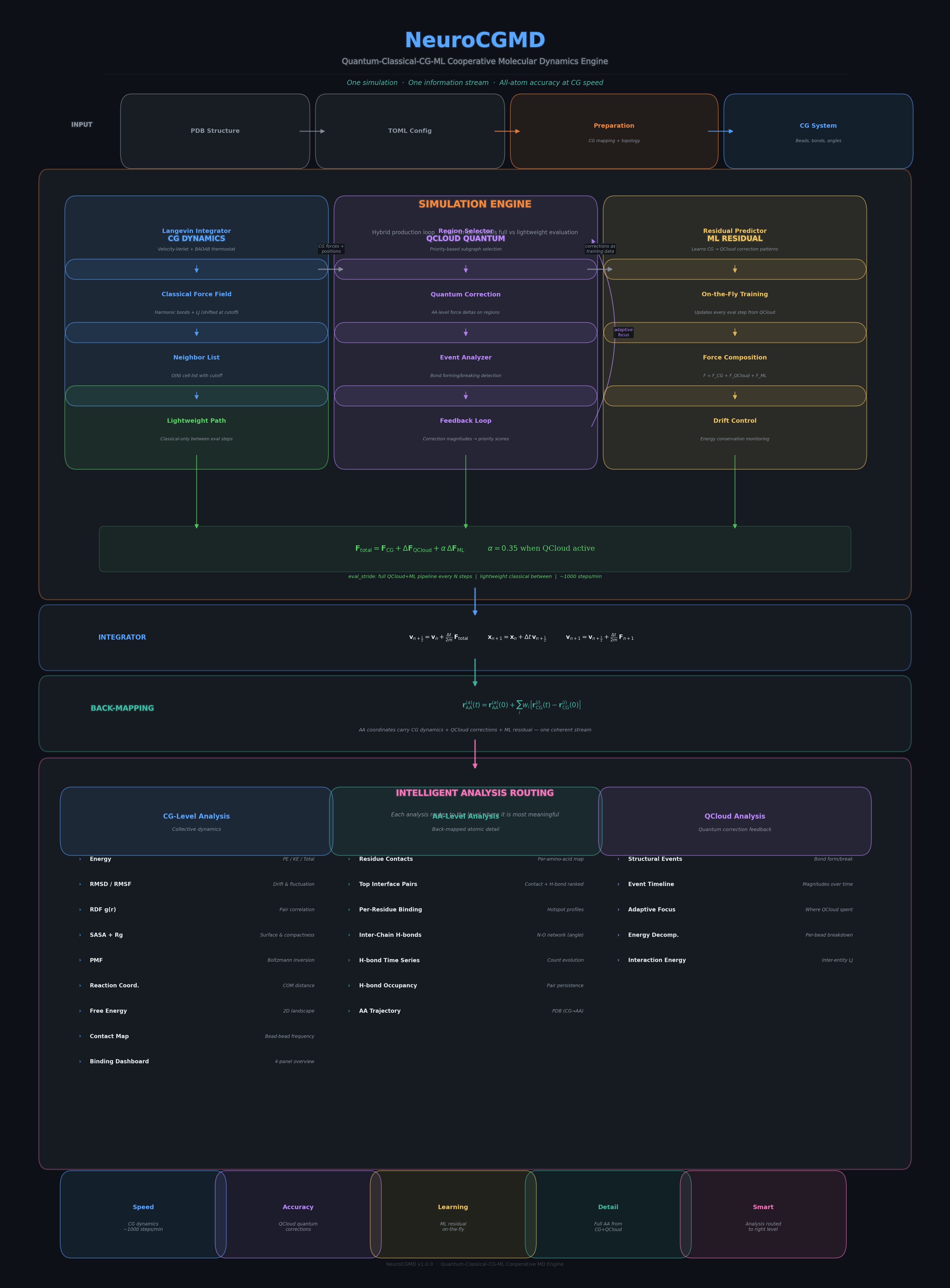
A documented simulation architecture that combines coarse-grained dynamics, selective force refinement, adaptive learning, and CG-to-AA reconstruction within one workflow.
Force composition
F_total = F_classical + F_QCloud + alpha * F_ML_residual

where alpha = 0.35 in the documented reference configuration when QCloud is active, 1.0 otherwise
Force propagation chain
| Stage | Operation |
|---|---|
| 1. Classical forces | Bonded (harmonic) + nonbonded (LJ shifted) + optional electrostatics |
| 2. QCloud coupling | Force deltas on selected regions, bounded and capped |
| 3. ML residual | Learned corrections, scaled when QCloud active |
| 4. Langevin integrator | Velocity-Verlet with thermostat: v += dt/2 * F/m, x += dt * v |
| 5. State update | New positions and velocities stored in state registry |
| 6. Back-mapping | CG → AA via interpolation (post-simulation) |
eval_stride architecture
The eval_stride parameter controls the frequency of full QCloud + ML evaluations:
- Full evaluation steps: classical + QCloud + ML + event analysis + feedback
- Reduced-overhead steps: classical-force propagation without the full refinement cycle
The appropriate eval_stride depends on the cost of the refinement layer and the objectives of the run. In practice, it functions as the main trade-off between refinement frequency and throughput.
QCloud feedback loop
The event analyzer tracks per-particle correction magnitudes with exponential decay. Spikes beyond the baseline trigger event classification and priority score updates that feed back into the next region selection cycle. This creates a closed-loop prioritization mechanism.